Why Cinema Lobbies Put So Much on Display
Why cinema lobbies put so much on display: see how posters, signs, and objects orient visitors and build anticipation before the screening begins.
Why cinema lobbies put so much on display becomes clear when you arrive at an unfamiliar theater with a few minutes to spare: you look for the right auditorium, notice the film’s images, and begin to settle into its mood before the lights go down. A lobby is not merely a waiting room. Its displays help turn the necessary walk from entrance to seat into the opening movement of a screening.
That work is easy to miss because each object seems to have a simple job. A poster names a film, a sign points toward a theater, and a stand holds something people can look at. Together, though, these objects shape how visitors read the building and what they expect to encounter inside. Consider one invented situation: a small neighborhood cinema is preparing to show a new adventure film in its larger auditorium, and its manager has an awkward, dim entrance passage to work with. The choices made there can either clarify the visit or leave people guessing.
What does a visitor need to understand first?
At the entrance, visitors are usually answering practical questions before they can attend to atmosphere: Where do I go? Is this the right screen? Can I pause here without blocking someone? A display that assumes everyone already knows the building may look composed but do little for a first-time guest.
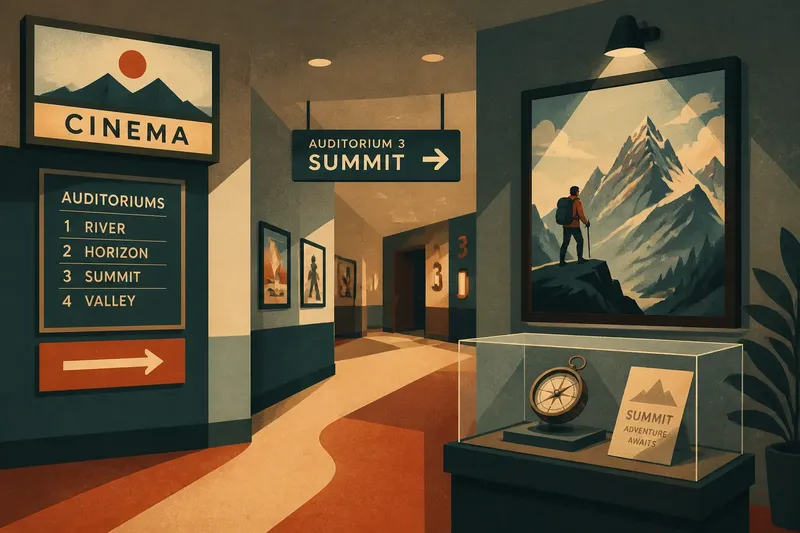
In the imagined cinema, the manager begins by treating the lobby as a sequence of decisions rather than an empty surface. The entrance sign identifies the cinema; a clear directory shows the auditorium names; a directional arrow points down the passage. The film’s poster appears after that basic information, where people can see it without mistaking it for a wayfinding sign.
This order matters because practical information and promotional material ask for different kinds of attention. A visitor searching for a theater number should not have to decode a collage of titles first. Conversely, putting every notice at the entrance can crowd the very spot where guests need room to stop, orient themselves, and let others pass.
A useful distinction is between finding and noticing. Finding depends on legible words, predictable placement, and a clear route. Noticing depends on contrast, scale, and the chance to look without holding up the flow of arrivals. A lobby display works best when it makes space for both.
How can a display build anticipation without telling the whole story?
Once visitors know where they are going, the lobby can give them a first impression of the film. A poster supplies a few visual cues: a color, a face, a landscape, or a suggestive object. A standee or small prop-like display can make the film’s world feel closer, but it should invite attention rather than claim to reproduce that world in full.
For the hypothetical adventure-film screening, the manager places a large image of a mountain pass along the wall beside the route to the auditorium. Near it, a simple display holds a replica compass and a card naming the film. The objects create a small pause in the walk. They do not explain the plot; instead, they give visitors a visual thread to carry toward the screen.
The manager avoids filling every bare patch with artwork. If several images compete for the same glance, each becomes harder to read, and the passage starts to feel like a sales display. A little open wall lets the main image register. It also gives the lobby a visual rhythm: information at the entrance, an image along the route, and the auditorium ahead.
What is not worth the effort? Adding decorative objects simply because a wall looks empty. A prop without a clear relationship to the film can distract from signage, collect dust, or narrow the passage. A small number of purposeful elements can make the space feel more considered than a dense arrangement that asks visitors to inspect everything.
How do displays work in a passageway rather than a gallery?
A lobby is a place people move through, so the best position for an object is not always the most dramatic one. A display that projects into the walking route may cause a bottleneck; one placed beyond a turn may be invisible until a visitor has already passed it. Sightlines matter as much as the object itself.
In the imagined setup, the manager keeps the central path clear and places the compass display against a wall where people can stop without standing in the stream of arrivals. The main auditorium sign remains visible from the entrance. The film image is far enough along the passage to reward a second glance, but not hidden behind a corner or a crowd.
Height and scale also affect how a display reads. A small card close to eye level can carry a title or a short invitation; a larger image can be seen from farther away. If every item is large, the lobby can feel visually noisy. If every item is small, visitors may not see the information until they are close enough to impede others.
Lighting changes the result. Glare on a framed poster can erase its image, while a dim corner can make a carefully chosen object disappear. The manager’s imagined adjustment is modest: shift the poster away from a reflective surface and keep the directory under even light. The point is not theatrical illumination, but legibility along the route.
What should the cinema change after watching people use the lobby?
The manager does not need a formal study to notice whether the arrangement is serving visitors. During the first arrivals, a guest pauses at the entrance and looks in both directions before choosing a corridor. Another stops in front of the compass display, then steps aside to let a family pass. These ordinary observations suggest where the display helps and where it may be asking too much of the passage.
Imagine the directory is readable but the arrow to the larger auditorium is partly obscured by the poster frame. The manager can shift the frame, then look again from the entrance. The expected result is straightforward and observable: a visitor can see the direction without stopping to search. This small adjustment is more useful than adding another sign that repeats the same information.
Displays also need a reason to change. A cinema might replace a film image when a new program arrives, remove an outdated notice, or move an object that has become an obstacle. A display that remains unchanged after its purpose has passed can make a lobby feel unattended, even if the rest of the room is clean and welcoming.
Care is part of the composition. Dust on a display case, a curling paper edge, or a stand placed at an awkward angle can draw attention away from the film and toward the upkeep. The manager can keep the arrangement simple enough to maintain, rather than designing a showcase that depends on constant additions.
Which lobby-display questions come up most often?
Should the film poster go near the entrance?
It can, if it does not compete with the directory or obscure the route. A poster along the passage may be more effective when visitors have already found the information they need to move forward.
Do interactive displays belong in a cinema lobby?
They can suit a lobby if they are easy to understand and do not block circulation. A simple object to view or a brief prompt is less likely to disrupt arrivals than a display that requires a long explanation or a queue.
How many objects should one film receive?
There is no useful universal count; the room and the objects’ jobs matter more. Keep an item if it adds a distinct visual cue or useful information, and reconsider it if it repeats what another display already says.
Can a small cinema create anticipation without elaborate props?
Yes. A well-placed poster, a clear title card, and a visible route to the auditorium can establish a film’s presence without custom fabrication. The arrangement should suit the available space and remain easy to maintain.
What does the imagined walk-through teach?
In the invented cinema, the result is not a transformed lobby but a more readable passage. Visitors can locate the auditorium, encounter an image connected to the film, and continue without navigating around a crowded display. The compass and mountain image add anticipation because they appear at the right moment in the walk, not because they explain everything.
That is the useful lesson behind why cinema lobbies put so much on display: their objects have to share a small stretch of space with directions, movement, and the attention people bring from outside. A cinema can make that stretch feel like part of the screening by giving each display a clear purpose and a place in the visitor’s route. For a manager deciding what to hang or set out, the best question is not how much the lobby can hold, but what a visitor should notice next.