From Handbill to Programme: Paper at the Movies
From handbill to programme, printed film material can announce a screening, orient an audience, or preserve its memory. Learn what each format does best.
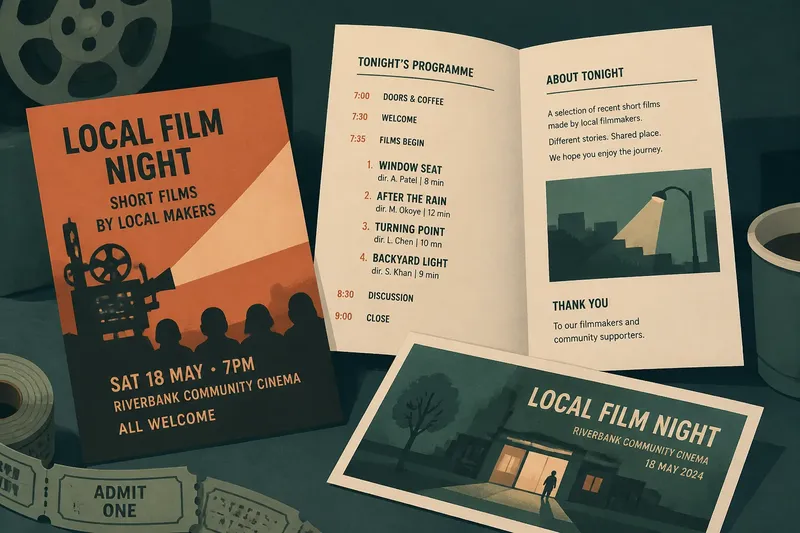
A handbill for a neighborhood screening might give you only a title, a venue, and a time; a folded programme can keep you reading after the lights come up. From handbill to programme, cinema paper developed not simply by getting longer, but by taking on different jobs: attracting an audience, helping it follow a screening, and giving it something to carry away.
Those jobs still make a useful way to understand printed film material. A brief announcement, a practical programme, and a keepsake each suit a different kind of event and audience. The right choice depends on whether people need to notice the screening, make sense of it, or remember it.
What does a handbill do best?
A handbill is a small, direct invitation. Its language and design have little room to wander: the film, the place, the date or time, and perhaps a short line that gives the event its character. That compression makes it easy to post, pass along, or tuck into a pocket.
In earlier filmgoing, such sheets could do the work of an announcement before a cinema’s regular program or local listings reached an audience. Their urgency is part of their appeal. A handbill says, in effect, that something is happening here, and you can decide whether to go.
This format suits a one-off screening, a neighborhood film series, or an event where the title and occasion are already enough to spark interest. It can also be useful when the film itself is the draw and there is little need to explain its background. A handbill need not pretend to be a miniature essay.
Its limit is equally clear: it has little space for context. If an audience may want to know who made the film, how the screening is arranged, or why it has been chosen, a bare announcement can leave useful questions unanswered. Adding tiny type to solve that problem often weakens the very clarity that makes the handbill effective.
When does a programme earn its extra pages?
A programme turns an announcement into a companion to the screening. It can include a schedule, a short note from the organizer, credits, or a brief explanation of a film’s place in a larger event. The extra material helps an audience understand what it is attending without asking the poster or the person at the door to do all the work.
Programmes suit festivals, repertory seasons, and screenings built around a particular subject. Their structure can also support films that need context, especially when titles are unfamiliar or shown together. A sequence of concise notes may help viewers see a connection that would not be obvious from a list of titles alone.
Paper and format affect how a programme feels in use. A single sheet is easy to scan and inexpensive in spirit, while a folded leaflet separates sections and creates a small sense of progression. A bound booklet can hold more, but should earn its bulk with writing or information readers will actually consult.
Good programme copy respects the film’s time and the reader’s attention. Short credits and clear practical details are often more useful than a long plot description, which may reveal too much or repeat what an audience can discover on screen. If the event has a conversation afterward, a note can point toward a question without supplying a verdict.
Which format suits the screening?
Imagine a small community cinema arranging an evening of short films by local makers. The organizer wants neighbors to notice the event, but also expects some guests to be new to the venue and curious about the films. A handbill with the essential details could travel through cafés and libraries; a one-sheet programme at the entrance could list the order, credits, and a few lines of context. The expected result is two clear encounters with the same event: an invitation before arrival and orientation on the night.
That division is often more useful than asking one piece of paper to do everything. A handbill speaks to a passerby who has not decided to attend; a programme serves someone who is already there. For a familiar, straightforward screening, one sheet may be enough. For a curated event with several films or a reason behind the selection, a programme can carry that reason with care.
A commemorative print is a third option, though it should not be confused with either format. A ticket, small card, or specially designed programme can become a memento when its visual detail recalls the occasion. It suits a premiere, a closing-night event, or a screening with a strong community identity; it is less useful if the audience mainly needs directions or film information.
Not every event needs a keepsake, and elaborate paper production is not worth the effort when the information could fit comfortably on a clear handbill. The object should add something the event genuinely needs: reach, understanding, or a tangible reminder. Decorative detail alone can turn a useful print piece into an obligation for its maker and a distraction for its reader.
What should a cinema programme tell you?
What belongs on a handbill?
Lead with the film or event name, then make the venue and screening time easy to locate. Add only the most useful invitation or access detail; anything that needs a paragraph may belong in a programme or a separate event notice.
Should a programme include a plot summary?
Usually, a compact description or curator’s note is more helpful than a full synopsis. Keep it free of surprises the audience may prefer to encounter in the film, and use the space to explain the event’s selection or sequence.
How can printed film material become a keepsake?
Give the paper a detail tied to the particular screening, such as a distinctive title treatment, a note about the event, or a design that reflects its subject. A memento feels meaningful when it recalls a specific occasion, not merely because it is printed on heavier stock.
How do you choose between a handbill and a programme?
Ask what the audience needs at each moment: a reason to attend, information while attending, or a reminder afterward. Choose the simplest format that meets that need, and add another only when it serves a different audience or moment.
How does paper preserve a moviegoing memory?
Printed film material can outlast the practical task that produced it. A handbill found in a drawer may bring back the act of deciding to go; a programme can recall the order of a night, the name of an unfamiliar film, or a note that framed the viewing. Paper gives memory specific handles: a title, a venue, a phrase, a fold worn from being carried.
For an organizer, the useful question is not how much can fit on the page, but what a reader should be able to do with it. Let the handbill make the event legible at a glance, the programme offer context without crowding the film, and a keepsake mark an occasion that merits remembering. From handbill to programme, each form makes a different promise to its reader; choosing the right one helps the screening speak before, during, and after the lights go down.