A First-Time Film Club Night, Built Around One Question
A first-time film club night can feel relaxed without going shapeless: choose one open question, give guests room to think, and keep discussion generous.
A first-time film club night can falter before anyone has finished a sentence: one guest launches into a plot recap, another apologizes for not knowing film jargon, and the host wonders whether to steer things back. The simplest repair is to build the gathering around one open-ended question, then let the evening’s small rituals make answering it feel easy.
This is not a seminar with a correct interpretation waiting at the end. It is a shared memory in the making: people notice different things, connect them to their own lives, and leave with a conversation that belongs to the room.
Why does the conversation turn into a plot recap?
People often retell the story when the first prompt is too broad. “What did you think?” can sound like an invitation to deliver a verdict, while a detailed plot question naturally sends everyone back through the events in order.
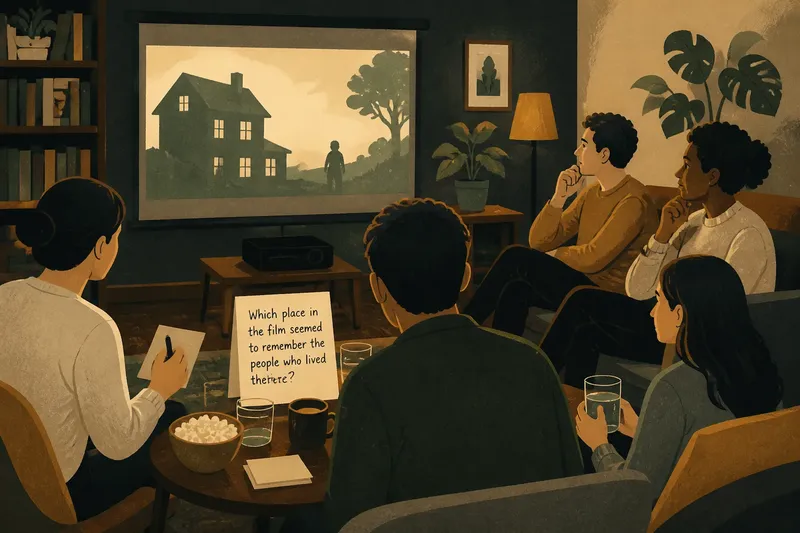
Choose one question that points toward an experience, image, or choice rather than a right answer. For a film about a family returning to an old home, you might ask, “Which place in the film seemed to remember the people who lived there?” The question gives guests something specific to hold onto without asking them to prove they followed every scene.
Write it on a card or a scrap of paper and leave it where people can see it. That quiet reminder can bring the conversation back when it wanders, without requiring the host to interrupt with a lecture.
What if the question sounds like a test?
A question can be open-ended in theory and still feel like an examination. Prompts about symbolism, technique, or what the director “meant” may suggest that guests need specialist knowledge before they can speak.
Use ordinary language and invite observation. “What stayed with you after the ending?” makes room for a line, a color, a sound, or a feeling; “What is the film’s central thesis?” asks people to perform an answer in a particular register.
It also helps to answer the question yourself briefly, without presenting your reading as the model. Mention one concrete detail you noticed, then leave space. Your example gives the group permission to be specific, not an instruction to agree.
How can a host make room for quiet guests?
Silence after the screening is not necessarily a problem to solve. Some people need a moment to gather a thought; others are comfortable listening and may speak only after the first exchange has loosened the room.
Build in a small pause before discussion begins. Offer water, let people settle, and give everyone a chance to write a word or image on a card if they prefer. A written note can serve as a starting point, but nobody needs to read theirs aloud.
If one guest keeps taking the floor, thank them for the thought and invite another angle: “I’d like to hear from someone who noticed something different.” Avoid making a quiet person the subject of the room by calling on them without warning. The aim is to open a door, not push someone through it.
What can you do when the group disagrees?
Disagreement is often the liveliest part of a film-club night, but it can sour when people begin defending a verdict instead of describing what they saw. Bring the exchange back to the scene or choice that prompted it.
Ask, “Which moment led you there?” or “What did you notice that made the character seem that way?” These follow-ups invite detail without turning the conversation into a contest. A guest can dislike a film and still have a thoughtful response to its mood, performances, or ending.
Keep the single central question in view, but do not force every comment to fit it. If the group discovers a more interesting thread, follow it for a while. The question is a handrail, not a fence.
How do you keep the evening from feeling overplanned?
A first gathering needs a few dependable pieces, not a packed schedule. Decide when people will arrive, where they can leave coats, how the film will be shown, and when you hope to begin talking. Let the rest remain loose enough for conversation to breathe.
Say in advance whether guests should watch the film before arriving or whether the club will watch together. If watching together, make the practical arrangements clear: where the screen is, how sound will work, and whether anyone needs to bring anything. Follow the equipment maker’s instructions and any applicable venue rules for setup.
Keep refreshments simple and place them where people can reach them without crossing in front of the screen. It is not worth the effort to create elaborate themed food or decorate every surface; those tasks can leave the host busy when the gathering’s real purpose is shared attention.
What should you do if the film itself leaves people cold?
Sometimes a group has little to say because the film did not connect for them. Treat that response as useful, not as a failure of taste or preparation. The central question can still open a conversation about distance, expectation, or the moment people stopped feeling engaged.
Imagine you chose a quiet drama and several guests found its long pauses frustrating. You could ask, “When did the silence feel expressive, and when did it feel like waiting?” People can point to different scenes, explain their reactions, and leave with a clearer sense of what did or did not work for them.
Do not rush to defend the selection or replace the discussion with a lesson about how it should be watched. If the room has reached its natural limit, close warmly and let the next gathering begin with a film the group chooses together.
Which questions do hosts often ask?
How many questions should a first film club night use?
Choose one main question and keep a couple of gentle follow-ups in reserve, such as “Which moment brought that to mind?” Too many prepared prompts can make the conversation feel like a worksheet.
Should the host explain the film before discussion?
Offer only practical context guests need to take part, such as whether the screening includes subtitles or a short break. Let the group meet the film before supplying an interpretation that could shape what people feel permitted to say.
What if nobody answers the opening question?
Wait a little, then share one small observation and ask whether anyone noticed the same or something different. If the room is still quiet, invite people to name a scene, sound, or image that stayed with them rather than insisting on an immediate response.
Can people leave before the discussion ends?
Yes; make the evening’s timing clear beforehand and let guests depart without an explanation. A relaxed invitation is more welcoming than an expectation that everyone must stay until the conversation runs out.
How should the first night end?
Close by asking each person, if they wish, to name one image or thought they are taking away. This is lighter than asking for a rating, and it gives the gathering a clear final beat without requiring consensus.
For a first-time film club night, the question should remain easy to remember and generous enough to hold different answers. Leave the card on the table, make a note of the thread the group followed, and let the next selection grow from that shared memory rather than from a need to top it.